
A few weeks ago I was talking to someone who runs a mid-sized audit practice. He told me they had cut their graduate intake by a third over the past two years. AI handles the preliminary review work now. The numbers look great on a spreadsheet.
I asked him who would be running the practice in ten years. He paused.
That pause is the article.
The numbers nobody is connecting
Entry-level hiring is falling off a cliff across every knowledge-work sector, and the data is no longer anecdotal.
Entry-level job postings across the economy are down 35% since January 2023. Graduate underemployment — people with degrees working jobs that do not require one — has hit 42.5%, the highest since COVID. The pattern holds everywhere you look: law firms, audit practices, consulting, finance, tech. The sectors differ, the direction does not.
A Stanford study found that workers aged 22–25 in AI-exposed occupations experienced a 16% employment decline — while older workers in the same fields did not. MIT Technology Review called it “a looming crisis in entry-level work.”
Every one of these numbers makes sense in isolation. AI handles the grunt work. Why hire someone to do what a model can do faster? The business case for each individual decision is sound.
The collective consequence is not.
How expertise is actually built
Here is the thing about entry-level roles that gets lost in the automation calculus. They are not just cheap labour. They are the training ground.
The junior auditor who manually reviews hundreds of transactions learns what a suspicious pattern looks like. The associate who drafts fifty discovery responses learns which arguments actually hold up. The analyst who builds financial models by hand learns where the numbers lie. The developer who debugs a hundred production incidents learns how systems actually fail, not how textbooks say they fail.
This is what researchers call cognitive apprenticeship. You cannot download it. You cannot shortcut it. It develops through repetition and mentorship over years. And it is the only mechanism we have ever had for producing the experienced professionals who eventually run these practices, these departments, these firms.
When you automate the grunt work, you are not just removing a task. You are removing the mechanism by which people develop the judgement to do the harder work that comes later.
Andrew McAfee at MIT put it directly: “How else are people going to learn to do the job except via on-the-job learning and training apprenticeship?”
Nobody has a good answer.
The Apprenticeship Gap
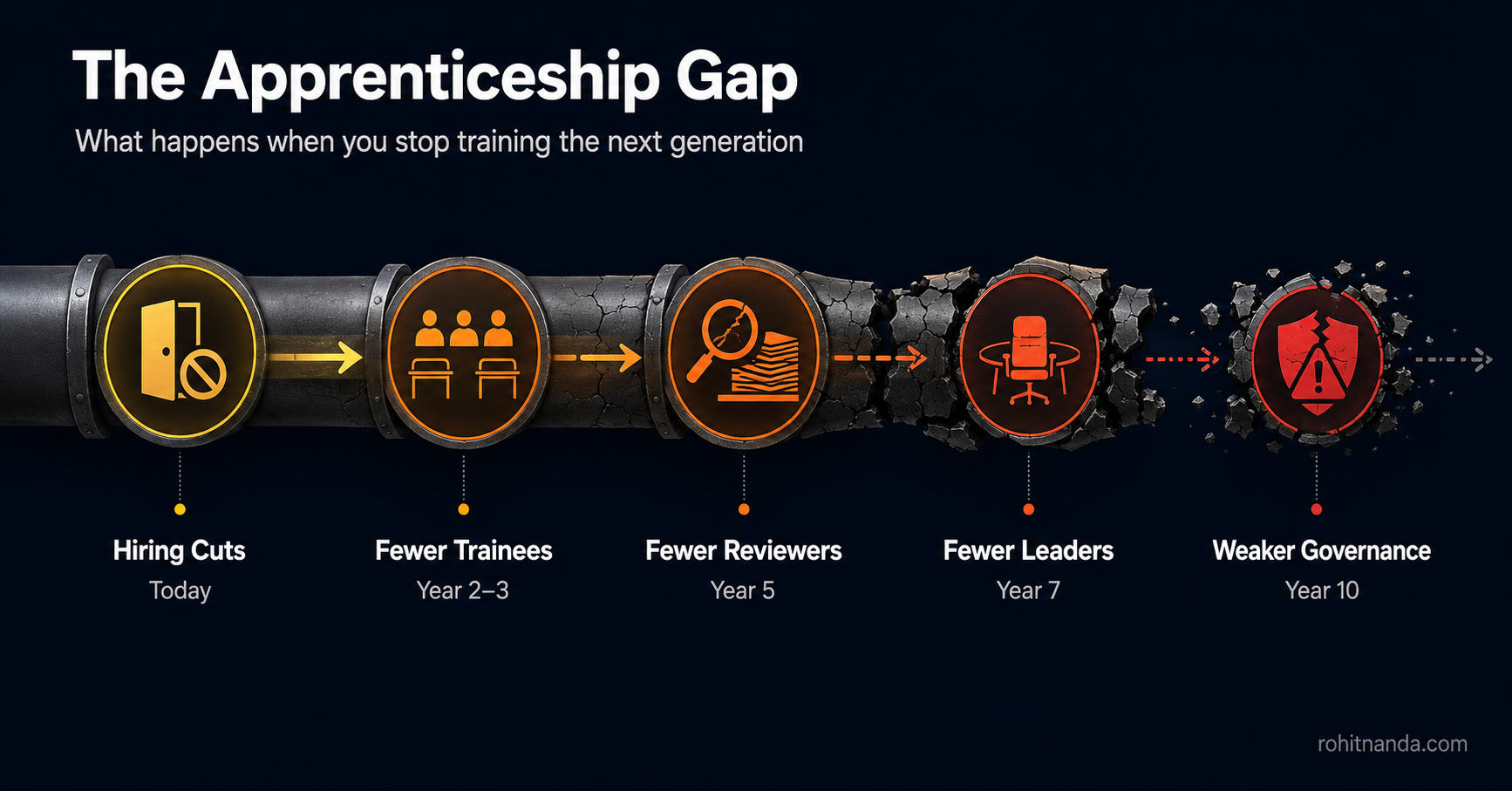
Each link in that chain takes years. A person hired today as a junior auditor, analyst, or associate needs five to seven years to develop the domain judgement that makes them a competent reviewer of AI output. That is not my estimate. It is what every professional services firm has observed for decades.
So the entry-level hiring cuts happening right now will not show up as a problem right now. They will show up in 2031. In 2032. In 2033.
By then, the senior professionals who learned the domain the old way will be retiring. The mid-level professionals who should have replaced them were never trained. And organisations will be sitting on sophisticated AI systems with nobody qualified to govern them.
The verification problem makes this worse
If AI were reliable enough to run unsupervised, the pipeline problem would not matter. You would not need experienced humans to verify what the machines produce. But AI is nowhere close to that threshold.
A Connext Global survey this year found that only 17% of workers consider AI reliable without human oversight. SonarSource’s 2026 developer survey reported that 96% of developers do not fully trust AI-generated code. The gap between what AI can do in a demo and what it does in production remains large — and closing it still depends on humans who know the domain well enough to catch what the machine gets wrong.
A system that is 85% accurate still requires 100% human review. That is the maths. And the humans doing the reviewing need to understand the domain well enough to spot the 15% — especially when, as I wrote in my last article, the wrong answers look polished.
Here is where it gets circular. The people qualified to do this verification are senior professionals. They got their expertise the old-fashioned way — by doing the entry-level work for years. And we are shutting down the pathway that produces their replacements.
The blind spot
Most corporate AI strategies cover model selection, deployment timelines, ROI projections, governance frameworks, responsible AI principles. Some of them are quite good.
What I have not seen — in any strategy document, any consulting framework, any board presentation — is a section that models what happens to the organisation’s talent pipeline when entry-level roles are automated. The question is straightforward: if we stop training juniors today, who reviews the AI output in 2031?
Gartner predicted this year that 75% of organisations pausing entry-level hiring will pay 15% wage premiums for early-career talent by 2030. That is the market’s way of correcting a supply problem. But wage premiums assume the talent exists somewhere and you just need to pay more for it. What happens when an entire generation never acquired the expertise in the first place? There is no premium high enough to hire people who do not exist.
The irony is that the organisations most aggressive about AI adoption are often the ones most exposed to this risk. They are cutting the deepest, automating the fastest, and seeing the best short-term numbers. The cost of what they are losing does not show up on any balance sheet. It materialises years later — as slower decision-making, as higher error rates in complex judgements, as increasing dependence on external consultants who charge a premium for the domain knowledge the firm used to build internally.
What this actually looks like
A case study documented by Knowledge at Wharton makes this concrete. A Fortune 500 company achieved 40% productivity gains with AI content generation. They have not hired junior copywriters in two years. Their senior writers are approaching retirement. When those writers leave, the institutional knowledge — the kind that was never codified because it lives in people’s heads — walks out the door with them.
McKinsey is an instructive case from the other direction. They cut 3,000 to 4,000 positions in 2025–26, concentrated in junior research and back-office roles. Then they announced they would increase entry-level hiring by 12% in 2026. Someone inside that building connected the dots.
Most organisations have not.
The firms that get this right will do something that looks counterintuitive in the short term. They will keep hiring juniors — not because they need the labour, but because they need the pipeline. They will redesign those roles around AI-augmented work, so the junior still processes ten times the volume but does it alongside the machine, learning the domain through the work rather than being replaced by it. The junior analyst who uses AI to review a thousand contracts still learns what a bad clause looks like. The one who gets replaced by AI learns nothing.
This is not philanthropy. It is workforce planning on a timeline longer than the next quarter.
The question
Every organisation’s AI strategy has a section on risk. Model risk. Data risk. Regulatory risk. Reputational risk.
Almost none of them have a section on this: what happens when you have powerful AI systems and nobody left who understands the domain well enough to know when those systems are wrong?
That is the biggest risk in your AI strategy.
And you are not measuring it.
Sources
Entry-level hiring decline & graduate underemployment
MIT Technology Review, “It’s time to address the looming crisis in entry-level work,” May 2026
Stanford study on AI-exposed occupations, cited in MIT Technology Review, May 2026
Federal Reserve Bank of New York, Labor Market for Recent College Graduates, Q4 2025
Cognitive apprenticeship & talent pipeline disruption
Knowledge at Wharton, “Is AI Pushing Us to Break the Talent Pipeline?,” 2026
Andrew McAfee (MIT), quoted in Fortune, “MIT AI expert warns automating Gen Z entry-level jobs could backfire,” May 2026
AI reliability & verification gap
Connext Global, 2026 AI Oversight Report
SonarSource, State of Code Developer Survey 2026
Faros AI, “The Hidden Cost Senior Engineers Pay” (PR review time data), 2026
Corporate strategy & workforce planning
Gartner, “Supply Chain Orgs Pausing Entry-Level Hiring Will Face Higher Costs by 2030,” May 2026
McKinsey workforce reductions and subsequent hiring increase: Bloomberg, HR Digest, April–May 2026
Fortune 500 case study
Knowledge at Wharton, “Is AI Pushing Us to Break the Talent Pipeline?,” 2026 (company anonymised in original)