
Most organisations are trying to deploy AI into systems that were never designed to accommodate uncertainty.
Over the past two years most organisations have launched AI pilots. Very few have deployed AI systems at scale.
This gap is often explained in technical terms — model quality, hallucinations, insufficient training data. In practice the failure usually has very little to do with the model.
Most enterprise AI projects fail for a much simpler reason: the organisation is not built to run probabilistic systems.
The Demo Problem
Most AI projects begin with a demo. A team uploads a few documents, asks a few questions, and the model produces surprisingly good answers. Executives leave the room convinced that the technology works.
In the demo environment the inputs are clean and the questions are well-framed. None of those conditions exist in production.
A proof of concept that worked beautifully in a controlled setting — curated documents, known questions, a technical person interpreting the results — stalled the moment it met real organisational data.
Inconsistent formats. Undefined terms. Users asking questions the system was never designed to handle.
It was never designed for reality.
The Verification Problem
AI outputs look correct even when they are wrong. A large language model produces an incorrect answer in exactly the same format and tone as a correct one. There is no red flag, no error message, no warning. The wrong answer looks identical to the right one.
In finance we have a word for accepting unverified information at face value: negligence. Every number in a financial report must trace to a source. Every claim in a due diligence report must be corroborated. The same discipline applies to AI — but most organisations have not built the infrastructure to apply it.
This means every AI output must be treated as unaudited until verified. Organisations that deploy AI without verification frameworks quickly discover they have built a system that produces confident answers and no reliable way to determine when those answers are wrong. In other words, the system can generate answers, but not accountability.
In effect, most organisations are deploying AI systems that produce answers without an audit trail.
The verification layer — source attribution, confidence scoring, automated cross-checks, audit trails — is the most important part of an enterprise AI system. It is also the part that most organisations skip entirely.
The Data Plumbing Problem
Enterprise data is rarely organised the way AI systems expect. Documents are inconsistent. Fields are missing. Naming conventions vary by department. The same concept is described differently in legal agreements, financial models, and board presentations.
When an AI system is prompted using poorly structured data it generates plausible answers from unreliable inputs. The output reads well. The underlying sources are wrong or incomplete. The model did not fail. The data infrastructure failed.
Anyone who has led an ERP implementation recognises this pattern. The technology works. The data does not. And cleaning the data takes three times longer than installing the software.
AI has the same problem, compounded by the fact that language models do not tell you when their inputs are bad. They simply produce the best answer they can from whatever they are given — and that answer will always sound authoritative.
The Control Problem
Traditional enterprise systems are deterministic. Given the same input they produce the same output every time. Payroll calculates the same salary. The ERP generates the same invoice. This predictability is the foundation of enterprise governance.
AI systems are probabilistic. The same prompt can produce different answers depending on context, retrieval, and internal model state. Most organisations do not yet have governance frameworks designed for systems that behave this way — because their entire IT stack was built for predictability.
When a deterministic system produces a wrong answer you fix the logic and the error disappears. When a probabilistic system produces a wrong answer you adjust the prompt, the retrieval pipeline, or the training data — and the error may or may not disappear. It may reappear under different conditions. It may produce a different error instead.
Managing probabilistic systems requires a fundamentally different approach to quality control: statistical validation instead of deterministic testing, confidence thresholds instead of pass/fail, continuous monitoring instead of release certification. Most enterprise IT teams are not equipped for this — not because they lack talent, but because the entire governance model was built for deterministic systems.
The Adoption Problem
Even when the technology works, AI projects often stall at the final step: adoption.
Replacing an existing workflow requires people to change habits built over years. Anyone who has implemented an ERP system knows that the technology is rarely the hardest part of the project. The hardest part is persuading a five-hundred-person organisation to work differently.
AI adoption faces the same resistance, with an additional challenge: trust. People trust deterministic systems because the output is predictable. They trust spreadsheets because they can see the formula. AI asks them to trust a system that cannot fully explain its reasoning. That is a significant psychological barrier, and no amount of accuracy improvement eliminates it.
The only thing that builds trust is time, transparency, and the ability to verify. Show people the sources behind every answer. Let them override the system when they disagree. Track when the system is right and when it is wrong. Publish the results. Trust is earned the same way in technology as it is in finance — through auditable performance over time.
What About Enterprise AI Subscriptions?
A question I hear frequently: don’t enterprise versions of Copilot, Gemini, or OpenAI solve this? These are frontier models — extraordinarily capable general-purpose intelligence. But it is worth understanding what “enterprise” actually means. Your data still leaves your infrastructure. Every query is an API call to an external server. The vendor commits contractually to not storing your data or using it for training — but the data does leave the building. You are trusting a policy, not controlling an outcome. For industries that handle confidential commercial terms, investor agreements, or regulatory filings, that distinction matters.
The Brain Without a Body
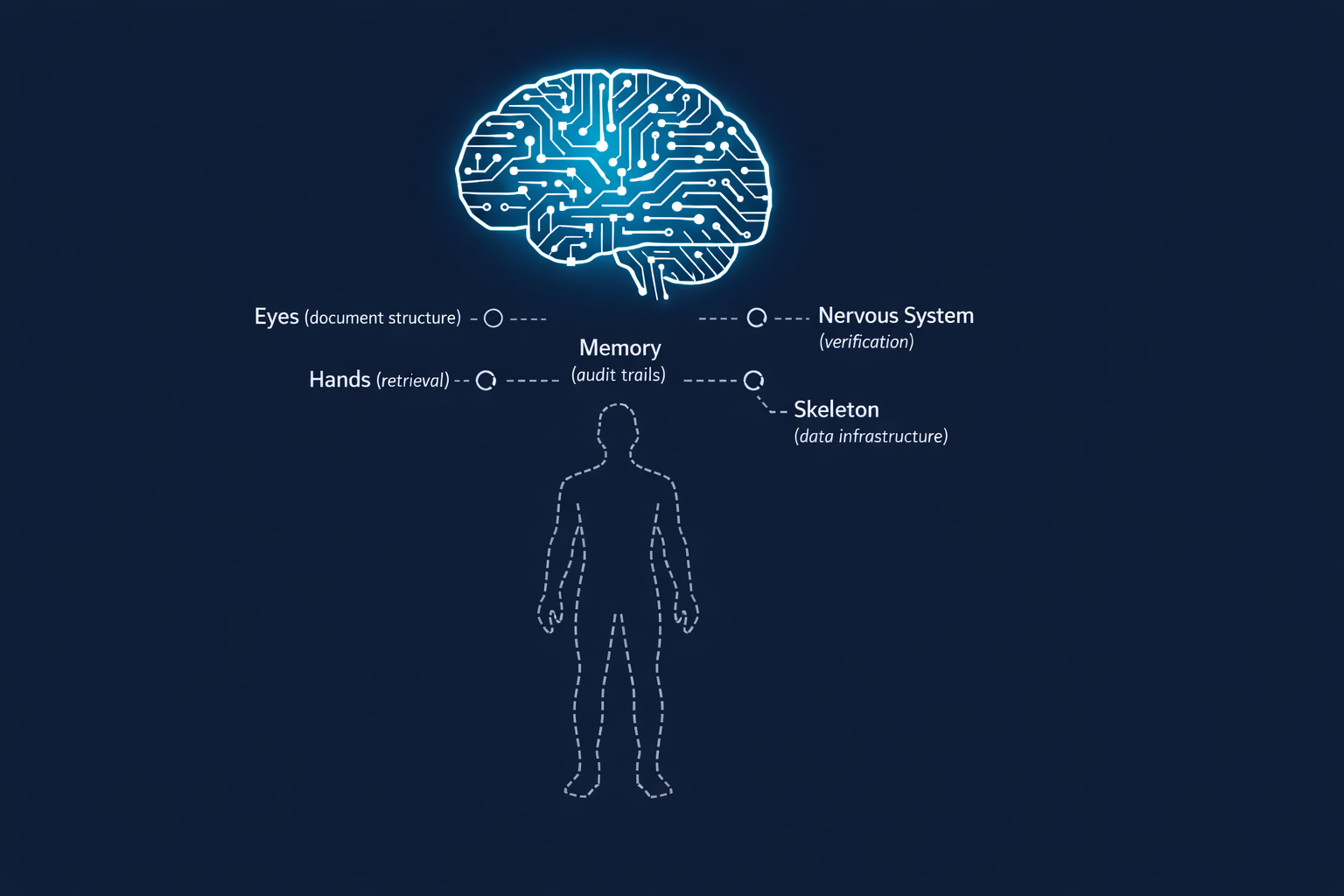
Even setting aside data control, there is a more fundamental limitation. A frontier model is a brain — extraordinarily powerful general-purpose intelligence. But a brain alone cannot function. It needs eyes to read your documents and understand their structure — not just the text, but the relationships between clauses, the hierarchy of sections, the defined terms that change meaning across agreements. It needs hands to retrieve the right information from the right source at the right time. It needs memory to track what it did, why it did it, and what sources it relied on. It needs a nervous system to verify its own outputs, flag low confidence, and stop before producing an answer it cannot support. Enterprise AI subscriptions give you the brain. The five problems in this article — the demo gap, verification, data plumbing, control, and adoption — are about building the body. Without that body, intelligence does not translate into reliable action.
The Real Bottleneck
Enterprise AI fails for five reasons: demos that don’t reflect reality, lack of verification, poor data plumbing, loss of control, and resistance to adoption.
When an AI project fails, the immediate reaction is to look for a better model. In most cases the organisation does not need a better model. It needs better governance.
Successful AI deployment requires the same capabilities that organisations already rely on for financial systems: verification frameworks, audit trails, access controls, process discipline, and accountability when errors occur.
These are not machine learning problems. They are management problems. And they are best solved by people who have spent their careers building governance systems — even if those systems were originally designed for financial reporting, regulatory compliance, or investment due diligence.
The model is a component. The system around it is what determines whether it works in production. And the person who builds that system needs to understand both the technology and the organisation.
That is not primarily an engineering role. It is a leadership role.